





Blog
What is a Broadsheet Newspaper? Definition, Sizes, & Examples
Origin, 332 × 475 mm dimensions, how it differs from the tabloid, and famous broadsheets past and present.
What is a broadsheet newspaper? Definition, sizes and examples
The broadsheet is one of the two great historical newspaper formats worldwide, alongside the tabloid. Larger and more imposing, traditionally associated with quality journalism and in-depth reporting, it has shaped the cultural image of the printed press since the 18th century.
Here is exactly what the term means, its precise dimensions, its history, and how it is used today beyond daily newspapers.
Broadsheet: the technical definition
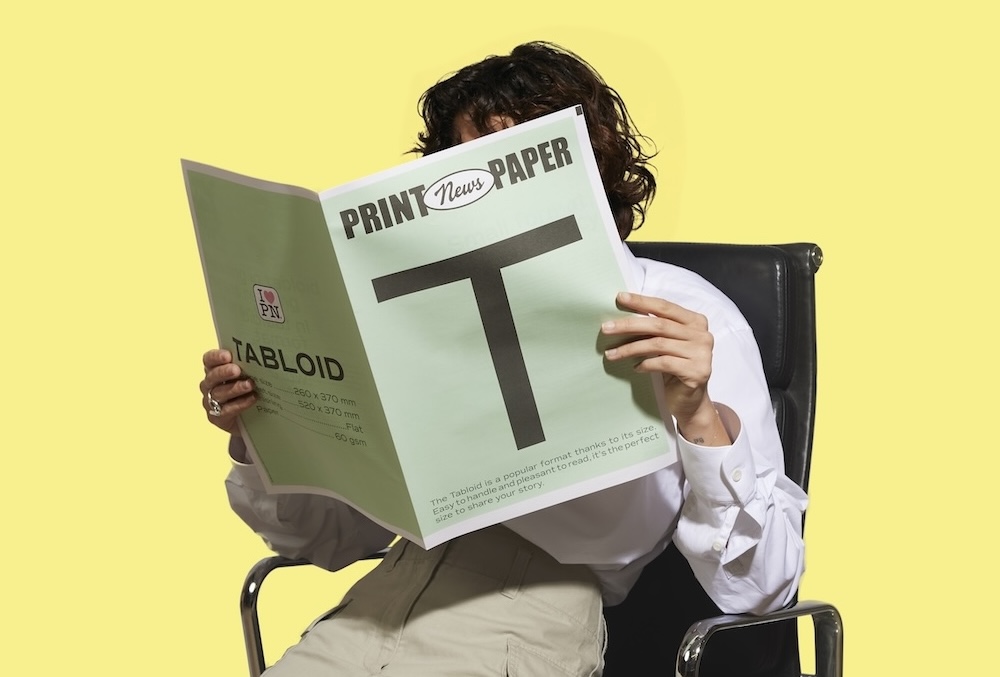
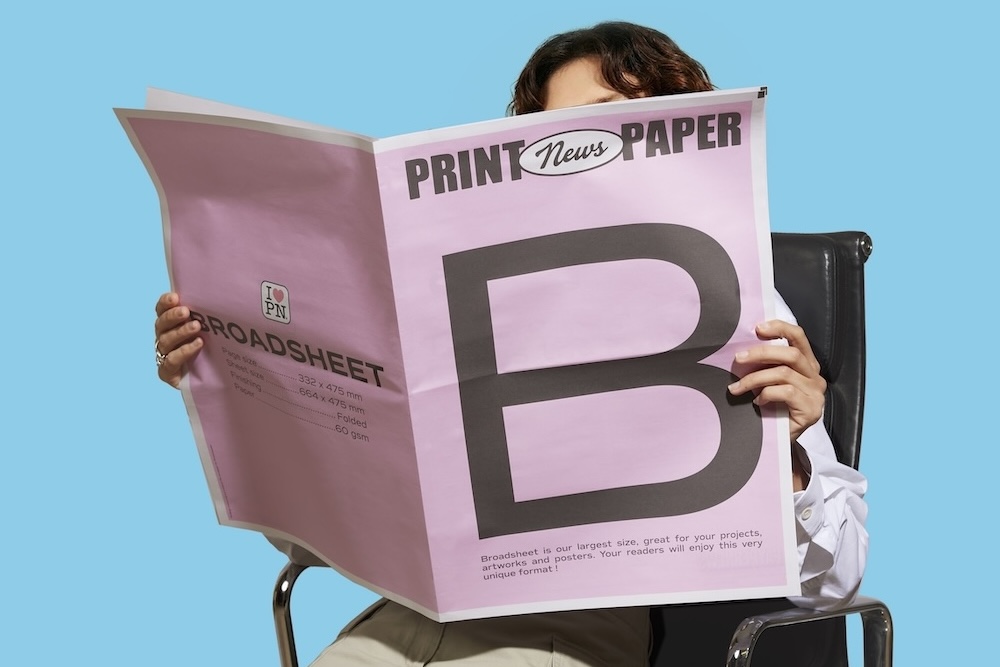
A broadsheet is a newspaper whose pages measure 332 × 475 mm (13.1 × 18.7 in) when closed. Opened out, the sheet measures 664 × 475 mm (26.1 × 18.7 in). Each page offers more than one and a half times the surface of a tabloid page (260 × 370 mm, or 10.2 × 14.6 in), making it the largest newspaper format still in common use.
The word literally means a "broad sheet". It originally referred to a print made on a single large sheet, as opposed to folded books and pamphlets. Over the 18th and 19th centuries, the term narrowed to describe the specific format of quality newspapers.
Dimensions vary slightly from country to country. The British broadsheet measures about 749 × 597 mm (29.5 × 23.5 in) before folding, the American broadsheet is slightly different, and Indian and Japanese broadsheets have their own standards. In continental Europe, the reference is a 332 × 475 mm page. For the full detail of broadsheet dimensions and other formats, see our dedicated guide.
The historical origin of the broadsheet
The broadsheet format dates back to the European press of the 18th century. In Britain, the Stamp Act of 1712 taxed newspapers by the number of pages, so publishers had every reason to print on very large sheets to reduce the number of taxed pages. One large folded sheet was printed instead of several small ones.
In the 19th century, the format settled and became a mark of distinction. The great national dailies (The Times, Le Figaro, The New York Times, and later Le Monde at its founding) adopted the broadsheet as their reference format. The tabloid appeared in the early 20th century for the popular press, creating the cultural divide between the two formats that still exists today.
When industrial rotary presses became widespread, they were designed to print broadsheets, and a tabloid was simply obtained by folding that sheet in half. This technical trick explains why both formats have been produced on the same equipment for more than a century.
The broadsheet as an editorial and cultural marker
Editorially, the broadsheet has historically been associated with quality journalism: long, analytical articles, a clear editorial hierarchy, restrained photography, little sensationalism. Most of the great writers of 20th-century journalism wrote for broadsheets.
This image was built in contrast to the tabloid, which became the format of the popular press. The broadsheet/tabloid divide long mirrored the divide between the quality press and the popular press, especially in the English-speaking world. For the other side of the story, see our tabloid definition.
That divide has shifted a lot since the 2000s. Several quality papers moved from broadsheet to tabloid, compact or the intermediate Berliner format (The Times, The Independent, The Guardian, Le Monde). Page size is no longer an automatic sign of editorial quality.
Iconic broadsheet newspapers
The Times (United Kingdom). Founded in 1785, a broadsheet until 2004, when it switched to a compact format. One of the most influential newspapers in history.
The New York Times (United States). Founded in 1851, a broadsheet ever since. It remains one of the few major quality dailies to have kept the historical format.
Le Figaro (France). Founded in 1826, a broadsheet for most of its history. It moved to a more compact format in the 2000s.
The Guardian (United Kingdom). Founded in 1821, a broadsheet until 2005, then the Berliner format, then tabloid in 2018.
Le Monde (France). Founded in 1944. A broadsheet until 2005, when it switched to the Berliner format.
The broadsheet today: decline and resilience
The broadsheet is in overall decline. Most of the major national dailies that used it have moved to more compact formats (tabloid, Berliner, compact) over the last two decades. Several factors explain this shift.
Urban life and commuting. A broadsheet is hard to read on the subway, on a train or in a coffee shop. The tabloid suits modern urban lifestyles better.
Printing costs. A larger format means more paper, more ink and a higher cost per copy. With falling circulations and pressure on newspaper margins, the tabloid has become more cost-effective.
Changing reading habits. Today's readers read more on the go, more by skimming, less in depth. The tabloid suits this quick reading better than the broadsheet, which was designed for long reading sessions.
The format still holds out in some places. The New York Times, The Washington Post and The Wall Street Journal are still broadsheets, as are several national dailies in Europe (in Germany, Spain and Italy). The broadsheet keeps an image of prestige and authority that justifies it for some established titles.
When to use a broadsheet for your own project
Beyond daily newspapers, the broadsheet has a place in many personal and professional projects.
A show-stopping wedding announcement. A 4-page broadsheet used as a wedding invitation creates a memorable "special edition" effect, in a format that breaks completely with traditional wedding stationery.
A premium wedding newspaper. For weddings that embrace a sense of spectacle, the broadsheet makes room for full-page photos, maps and illustrated timelines. Maximum visual impact. Learn more on our wedding newspaper page.
An ambitious editorial project. For an art zine, an independent magazine or a bold design project, the broadsheet offers a generous surface that showcases large photographs and illustrations.
High-end corporate communication. Annual report, brand launch, prestige publication: a broadsheet company newspaper instantly signals a premium product.
Keepsakes and collectibles. A broadsheet printed for a milestone event (a company's 50th anniversary, a jubilee, the retirement of a leading figure) becomes a collector's item that recipients keep.
How to print a broadsheet project
Broadsheet printing runs on the same industrial web presses as the tabloid, with the same technical constraints. The two formats differ mainly in surface area, but the margins (10 mm, or 0.4 in), bleed (3 mm, or 0.12 in) and page count in multiples of 4 are the same. The main practical difference: a broadsheet weighs more than a tabloid when shipped, which can influence your choice for large-scale distribution.
To decide for your specific project, our tabloid vs broadsheet guide for your brand covers the selection criteria by use case. To place the other formats in context, our comparison of the three formats (tabloid, broadsheet, A3) lays out the technical essentials.
The price simulator gives you the cost of a broadsheet project based on page count and quantity, and a free sample lets you get a feel for the format before ordering.
The broadsheet, a format that adds value
Although it is now a minority in the contemporary press, the broadsheet still adds instant value to projects that want to convey prestige, create a keepsake or make a visual statement. Understanding this format, its history and its uses means you can use it wisely when it fits, and choose the tabloid when that fits better.